

Connecting With What You Can Control…and feeling capable again
Something about Spring has us paying attention (Spring Cleaning got its name from something!). We can start noticing what isn’t working and start asking better questions, like “what am I actually in charge of here?”. Let’s talk about three places where you actually have influence: your sleep, how you handle change, and the relationship that shapes every other one in your life- the one with yourself!
Taking Charge of Sleep: Evidence-Based Strategies That Actually Work
If you’ve worked with me, you’ve heard me hierarchy mental health requirements, and sleep has always been at the very top. There’s a new book, Hello Sleep by Jade Wu, and I was curious about the latest research. She talks about tracking sleep efficiency and suggests a sleep consensus diary, which I kept for the recommended two weeks just to see if I could practice what I preach (93% sleep efficiency, not too shabby!).
I really liked this message from the book: most people who say “I’ve never been a good sleeper” often unknowingly trained their brains. You have a few bad nights. You stay in bed awake, trying to force sleep. Your brain starts pairing the bed with alertness, problem-solving, frustration, clock-watching… instead of sleep. And Wu promises what gets learned can get unlearned.
One distinction worth making: tired and sleepy are not the same thing. Tired is physical fatigue, even stress. Sleepy means your eyes are heavy. Go to bed when you’re sleepy. This is the foundation of sleep efficiency, and it’s more important than total hours. Poor sleep is strongly linked with anxiety, depression, emotional dysregulation, and difficulty concentrating. Starting here is important!
Here’s what Wu says actually works, and what other sleep behaviorists have said for years:
• Fixed wake time, every day (yes, weekends too).
• No naps! If you’re exhausted, go to bed earlier instead.
• Bed is for sleep, sex, and bedtime reading only (not scrolling or planning).
• If you’re awake more than 20 minutes, stop trying to sleep. I keep fiction on my nightstand for exactly this. (Some people also find cognitive shuffling helpful, as discussed recently here.)
• Prioritize light during the day (morning sun, a walk, or a daylight lamp. I even bought one during Snowmageddon 2010 before recommending it to clients).
• Watch how you talk to yourself about sleep: I never sleep well is a story you tell yourself. Wu’s reframe: my body knows how to sleep; even rest is restorative. Your narrative about your nights matter (I have an old A to Z list of sleep tips- if you want me to forward just ask!)
These strategies overlap with a lot of Cognitive Behavioral Therapy for Insomnia, or CBT-I, one of the gold standard treatment for chronic sleep issues, made accessible for everyday use. David Krzysko is one of our own experts in CBT!
Taking Charge of Change: How to Navigate Uncertainty Successfully
Change is, interestingly, where we learn what we can and can’t control. I say this multiple times a week: we cannot control other people; we can only control our reactions to them… And yet many people spend enormous energy trying to do the opposite.
Maya Shankar’s The Other Side of Change argues that change doesn’t just happen to us, it happens within us, and identity can get rattled or unwound when roles we hold change. Who we become depends largely on how rigidly we’ve defined ourselves going in. If your identity is anchored to what you do, like your title, your role, your relationship, then any threat to that thing is a threat to your whole self. The fix is “identity flexibility”. Define yourself by why you do things instead. That’s harder to take away.
Lewis Carroll’s Alice in Wonderland in response to “Who are you”, Alice answers: “I hardly know… I know who I WAS when I got up this morning, but I think I must have been changed several times since then”
So ask yourself: who else am I? If you genuinely don’t know, then that’s the most important place to start. (That’s exactly what therapy can be used for.) And in the absence of that answer, we’re also most vulnerable to the two things that can reinforce each other: loneliness and rumination. A lot of us have more uncertainty and ambiguity than we let on. The less we need cognitive closure (that urgent need to have things resolved and decided) the less we ruminate. This tolerance is a skill and it can be built! In psychology/clinical terms, this is called tolerance for ambiguity, and people who build it tend to ruminate less and feel less overwhelmed.
Shankar points to something else worth thinking about: many of the beliefs we carry about who we are and what we deserve were formed long before we ever questioned them. Metacognitive awareness is the moment you realize those beliefs aren’t necessarily facts, but interpretations. That realization can feel like a gut punch at first. But it’s also what creates the flexibility needed for change (I love witnessing these moments for you in my office). Self-compassion is a cure because it allows adjustment when external change changes us internally. Who do you want to become in response?
Here’s how to actually take charge of change:
- Mental time travel- ask how you’ll see this moment in five years. Perspective can loosen the grip of right now. (“Fresh start effect”)
- Affect labeling- name the feeling precisely. Not “bad.” Angry? Scared? Grieving? Naming reduces intensity. (This isn’t just therapist talk- it is neuroscience!)
- Self-distancing- talk to yourself in the third person when spiraling. It helps!
- Moral elevation- seek what moves you: courage, kindness, awe, nature. It widens perspective.
- Self-affirmation- remind yourself what you value and who you are. (Ask me for my list- it’s quite a list.)
Taking Charge of Yourself: Emotional Regulation, Attachment, and Relationships
Sleep and change matter, but honestly, what matters most is this: How are YOU doing? Because you can optimize your sleep and navigate change, and you might still feel like something is off. That something might be you, your relationship with yourself, and by extension, everyone else.
What I notice in therapy is that the session changes when a client really starts looking inward. Honestly, self-reflection is where therapy so consistently works.
I went down an Irvin Yalom rabbit hole last year because his style felt so familiar to me. He says this repeatedly: therapy works through the relationship, not the technique (so totally my language!). The most healing moments are often the simplest ones. The showing up, being honest, reflective, and vulnerable in a genuine therapeutic connection and that heals.
Understanding attachment styles (anxious, avoidant, disorganized, or secure) is one clarifying insight a person can do in therapy. It is one I’ve gone deep on professionally.  How we learned to connect as children shapes our emotional regulation and shows up everywhere: in how we handle conflict, in who we choose, in whether we can ask for what we need without shame. Self-compassion (not self-pity! It’s accountability without the cruelty) is a clinical foundation of emotional regulation. And understanding your attachment style, not as blame, but as context, can result in finally having validation and even closure.
(If the word “self” feels complicated, there’s actually a clinical term for when early relational trauma disrupts how someone regulates emotions, sees themselves, and navigates relationships: Disturbances in Self-Organization, or DSO. I talk more about this on my social media in April, 2026). It affects three specific things: how you regulate emotions, how you see yourself, and how you experience relationships. Not because of who you are, but because of what you had to organize yourself around. The hopeful part is that the way your system organized itself can also be reorganized, with awareness, regulation, and safer relationships.)
So here’s what taking charge of yourself actually looks like:
- Look at your part- not your partner, your boss, your parent. Yours. What’s your part? What’s your pattern? What’s your role? And don’t forget the necessary component of self-compassion, not blame/shame.
- Know your attachment style (anxious, avoidant, disorganized, or secure) and WHY you have it– are you anxious, avoidant, or somewhere in between? It explains more than you think. (Ask me- this is my wheelhouse.)
- Notice your self-talk in relationships- the stories you tell yourself about what others mean can be more about you than them.
- Practice being known, selectively and intentionally-in therapy, in friendship, in partnership. Not everyone earns your full story, but who should? Intimacy is a skill, and like any skill, it requires a safe enough place to practice.
- Revisit the “who else am I?” question here too- because how you define yourself affects how you show up in every relationship you have.
Self-compassion (with self reflection) is still the requirement. You cannot be genuinely available to others while running on empty or while beating yourself up. Try replacing “I can’t believe I did that” with “that was hard and I did my best.”
(If emotional regulation is something you want to understand more deeply (including how reframing actually works) I wrote about it in my recent City Lifestyle article (April, 2026) 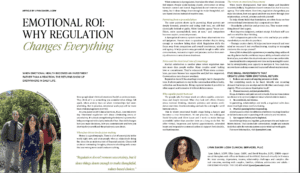
You don’t have to have it figured out. That’s what the work is for. Stay curious about what feels unresolved; curiosity is usually how clarity finds its way in.
Lynn Zakeri, LCSW, is a Chicago-area therapist specializing in attachment, emotional regulation, and relationships. Reach out here
